Satyanarayan Puja Mantra: Complete List & Meaning (Vedic Guide)
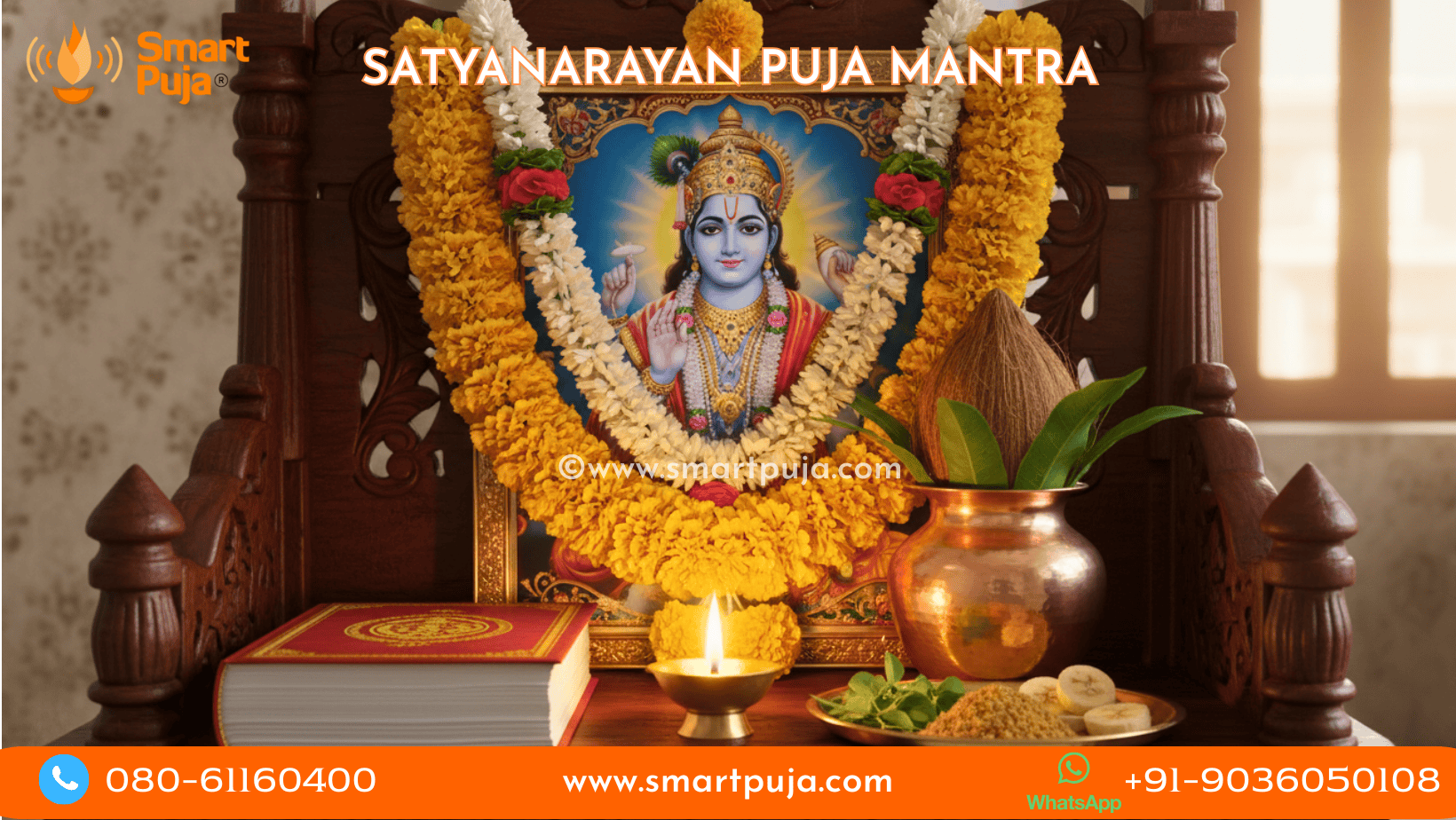
Satyanarayan Puja Mantra: Complete 16 Steps & Katha Mantras
Satyanarayan Puja Mantra: The Satyanarayan Puja involves specific Vedic mantras recited during the 16-step (Shodashopachara) ritual to invoke Lord Vishnu’s blessings. Chanting these mantras ensures prosperity, family harmony, and the swift fulfillment of desires.
Mantras—the sacred utterances in Hinduism—are melodious instruments of the mind designed with mathematical precision. In Vedic culture, sound (Shabda) is considered the first manifestation of the divine. Every Satyanarayan Puja mantra has a specific frequency that aligns your mind with cosmic energy.
The Satyanarayan Puja is a powerful ritual performed to seek the blessings of Lord Vishnu as the embodiment of Eternal Truth (Satya). While listening to the Katha (story) is vital, the core spiritual power of the ceremony lies in the Shodashopachara Vidhi—the 16 traditional steps of welcoming and serving the deity.
In this comprehensive guide, we provide the complete Satyanarayan Puja mantra list in Sanskrit (Devanagari) and English transliteration, their deep meanings, and the essential chants required during the Katha.
📋 Table of Contents
1. The Origin & Significance of the Puja
The rituals and mantras of the Satyanarayan Puja find their origin in the Reva Kanda of the ancient Skanda Purana. The text explains that the sage Narada asked Lord Vishnu for a simple, accessible remedy to alleviate the sufferings of humanity in the Kali Yuga. Lord Vishnu revealed that worshipping Him as Lord Satyanarayan (the highest truth) with devotion and a pure heart would immediately grant peace and prosperity.
2. The 16 Steps: Shodashopachara Mantras
A traditional and complete Satyanarayan Puja involves 16 Upacharas (Offerings/Steps). Here are the essential mantras for the key steps in both Sanskrit and English transliteration.
1. Dhyanam (Meditation)
Invoke the Lord in your mind before beginning the external worship.
लोकनाथं त्रिलोकेशं कौस्तुभाभरणं हरिम् ॥
Lokanatham Trilokesham Kaustubhabharanam Harim ||
2. Avahanam (Invocation)
Invite Lord Satyanarayan and Goddess Lakshmi to take their seat in the idol/photo.
इमां मया कृतां पूजां गृहाण सुरसत्तम ॥
Imam Maya Kritam Pujam Grihana Surasattama ||
Om Shri Lakshmi Sahita Shri Satyanarayanaya Avahayami |
3. Asanam (Offering Seat)
Offer a mental seat decorated with gems and gold.
आसनं देवदेवेश प्रीत्यर्थं प्रतिगृह्यताम् ॥
Asanam Devadevesha! Prityartham Pratigrihyatam ||
Om Shri Satyanarayanaya Namah Asanam Samarpayami |
4. Padyam & Arghyam (Washing Feet & Hands)
Offer pure water to wash the Lord’s feet and hands.
पाद्यं गृहाण देवेश मम सौख्यं विवर्धय ॥
Padyam Grihana Devesha! Mama Saukhyam Vivardhaya ||
Om Shri Satyanarayanaya Namah Padayoh Padyam Samarpayami |
5. Panchamrita Snanam (Holy Bath)
Bathe the deity with the five sacred nectars (Milk, Curd, Ghee, Honey, Sugar).
Anathanatha Sarvajna Girvana Pranatapriya ||
Om Shri Satyanarayanaya Namah Panchamrita Snanam Samarpayami |
6. Vastram & Yajnopavitam (Clothes & Sacred Thread)
Offer new clothes (Yellow or Red cloth) and the sacred thread to the deity.
Dehalankaranam Vastra Prityartham Pratigrihyatam ||
Om Shri Satyanarayanaya Namah Vastra Yugmam Samarpayami |
7-15. Gandham, Pushpam, Naivedyam (Sandalwood, Flowers, Food)
Offer Chandan (Sandalwood paste), fresh flowers, Tulsi leaves, and the sacred food (Prasad/Sheera/Panjiri).
Nanavidham Cha Naivedyam Grihininva Surasattama ||
Om Shri Satyanarayanaya Namah Naivedyam Nivedayami |
16. Aarti (Final Prayer)
Perform the Mangal Aarti with a lit camphor or ghee lamp.
Arartikyamaham Kurve Pashya Me Varado Bhava ||
Om Shri Satyanarayanaya Namah Mangala Aartim Samarpayami |
3. Mantras Chanted During the Satyanarayan Katha
The Satyanarayan Katha consists of 5 chapters. At the end of each chapter, the Pandit guides the family to throw flowers and Akshat (rice) towards the deity while chanting:
“Om Shri Satyanarayanaya Namah”
(I bow to the Supreme Truth, Lord Satyanarayan)
Additionally, the powerful “Om Namo Bhagavate Vasudevaya” meaning “I bow to the Lord who dwells within all beings,” is continuously chanted by the family members during the story reading to maintain a highly spiritual atmosphere.
4. Printable Satyanarayan Puja Mantra PDF
Many families prefer having a printed copy of these mantras to chant along with the Pandit. You can bookmark this page on your phone, or convert into a Satyanarayan Puja Mantra PDF booklet.
Explore the Vishnu Puja Cluster
Enhance your spiritual knowledge by exploring our related guides:
- 📅 Fasting Guide: Learn about the upcoming Ekadashi Dates.
- 🏡 New Beginnings: The Satyanarayan Puja is highly recommended immediately after a Griha Pravesh Puja.
- 🌕 Auspicious Days: Discover the complete list of Purnima Dates for 2026.
5. Why Professional Chanting is Important
While devotion is the most important element of any prayer, Vedic mantras are essentially sound science. A proper Uccharan (pronunciation) is vital to unlock the full vibrational benefits of the puja and to correct any planetary doshas in your household.
Ensure a Flawless Satyanarayan Puja
If you are unsure about the Sanskrit pronunciation or the complex 16-step Vidhi, it is best to hire a professional. SmartPuja provides experienced, verified Vedic Pandits who perform the entire Shodashopachara ritual with authentic, resonant chanting.
- ✔ All Samagri Included: We bring high-quality puja items, flowers, and leaves.
- ✔ Language Preferences: Hindi, Kannada, Telugu, Tamil, Marathi & more.
- ✔ Pan-India Service: Available in Bangalore, Mumbai, Delhi, Hyderabad, Pune, and Chennai.
Frequently Asked Questions (FAQs)
Place the deity (Idol/Photo) facing West so that the devotee faces East or North while chanting mantras. This aligns the body with positive solar and magnetic energies.
Yes, you can perform a simple puja yourself by chanting ‘Om Namo Bhagavate Vasudevaya’. However, for the complete Vedic ritual with all 16 steps (Shodashopachara) and proper Sanskrit pronunciation, it is highly recommended to book an experienced Pandit.
The primary and most powerful mantra is ‘Om Namo Bhagavate Vasudevaya’ (I bow to the Supreme Lord Vasudeva/Vishnu). Chanting this continuously throughout the day invokes massive spiritual blessings.
The most auspicious time to perform this puja is on Purnima (Full Moon day) or Ekadashi. It is also highly recommended after significant life events like a Griha Pravesh (Housewarming) or marriage.
📍 Find Vedic Pandits in Your City