Karma in Hinduism Explained: Types, Laws & How to…
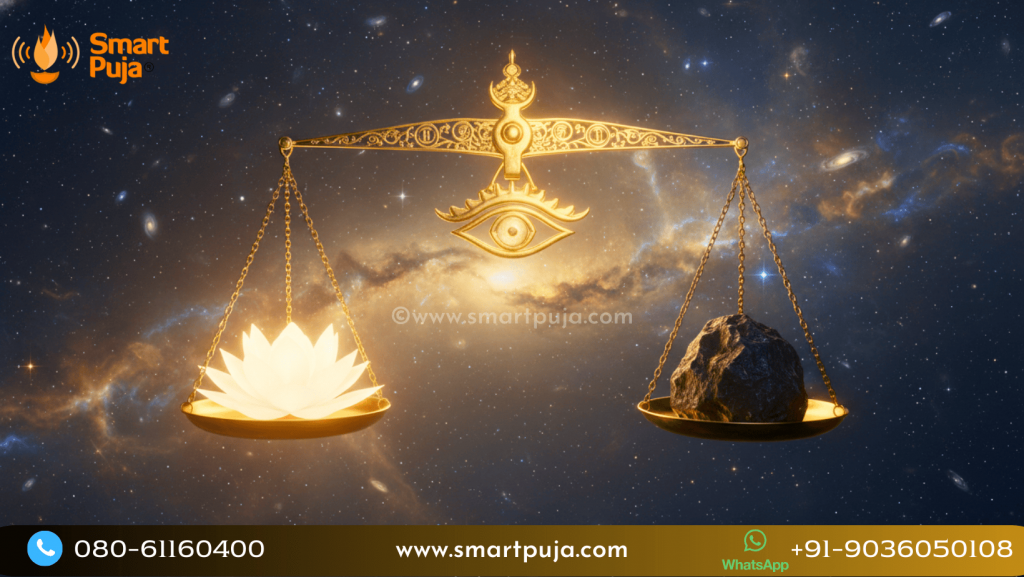
Karma in Hinduism Explained: Types, Laws & How to Clear Bad Karma
Karma in Hinduism is the spiritual law of cause and effect that governs the consequences of a soul’s actions, thoughts, and words across multiple lifetimes.
Have you ever wondered why seemingly inexplicable events happen in life? Or why some individuals face constant struggles while others experience smooth paths? In Hindu philosophy, the answer does not lie in random chance or a punishing deity, but in the infallible, mathematical law of Karma.
Karma is the spiritual engine that drives the cycle of reincarnation (Samsara). Understanding the journey of the soul requires a deep understanding of how karmic debts are accumulated and, more importantly, how they can be cleared.
What is the Law of Karma?
The Law of Karma is not a system of cosmic revenge; it is simply a law of physics applied to the spiritual realm. Just as gravity pulls an object to the ground, a negative action pulls a corresponding consequence back to the doer. Good deeds generate spiritual merit (Punya), leading to peace, while bad deeds generate spiritual debt (Paap), leading to future suffering.
Where is Karma Explained in Hindu Scriptures?
The concept of Karma is foundational to all Sanatana Dharma and is extensively detailed across primary texts:
- The Upanishads: The Brihadaranyaka Upanishad clearly states, “As a man acts, so does he become. A man of good deeds becomes good, a man of bad deeds, bad.”
- The Bhagavad Gita: In Chapter 4 (Karma Yoga), Lord Krishna explains the intricate nature of action, inaction, and the path to performing duties without accumulating karmic bondage.
- The Garuda Purana: Details exactly how accumulated karma dictates the soul’s journey after death and its next reincarnation.
The Bhagavad Gita on Karma (Chapter 2, Verse 47)
मा कर्मफलहेतुर्भूर्मा ते सङ्गोऽस्त्वकर्मणि ||”
“You have a right to perform your prescribed duty, but you are not entitled to the fruits of action. Never consider yourself the cause of the results of your activities, and never be attached to not doing your duty.”
The 3 Types of Karma in Hinduism
Not all karma affects you at the same time. Hindu scriptures elegantly categorize karma into three distinct “accounts.” For a deeper dive into these classifications, you can read our detailed guide on the Types of Karma.
| Type of Karma | Meaning | Analogy |
|---|---|---|
| 1. Sanchita Karma | The vast, accumulated storehouse of all karma from millions of past lives. | The total grains of rice stored in a massive warehouse. |
| 2. Prarabdha Karma | The specific portion of past karma that is active and destined to be experienced in this current life. | A handful of rice taken from the warehouse to be cooked today. |
| 3. Agami (Kriyamana) Karma | The new karma you are creating right now through your current choices and actions. | The seeds of rice you are planting today for future harvests. |
1. Sanchita Karma (The Cosmic Warehouse)
Every action you have ever taken since your soul was created is recorded here. It is impossible to experience all of Sanchita Karma in one lifetime. This vast repository is why the soul must undergo reincarnation—to slowly work through this massive account.
2. Prarabdha Karma (Your Current Destiny)
Before you are born, a specific slice of your Sanchita Karma is allocated to you. This is Prarabdha Karma. It dictates your parents, your physical body, major life events, and the overall trajectory of your life.
3. Agami & Kriyamana Karma (Your Free Will)
This is the karma of the present moment. By using your intellect and free will to make good choices today, you create positive Agami karma, which will eventually alter your future destiny.
Is Karma Fatalistic? (Free Will vs. Destiny)
A common misunderstanding is that Karma implies strict fatalism—that everything is predetermined and human effort is useless. Hinduism strongly rejects this.
While your Prarabdha Karma creates the exact circumstances you are placed in (your destiny), your Free Will lies entirely in how you choose to react to those circumstances today. You cannot control the cards you were dealt from past lives, but you have absolute freedom in how you play the hand. Making conscious, righteous choices today is how you break the cycle.
Signs You May Be Experiencing Past-Life Karmic Blockages
In Vedic Astrology (Jyotish), your birth chart is considered a literal map of your Prarabdha Karma. When past-life negative actions manifest in this life, they are traditionally interpreted as planetary blockages or “Doshas.”
- Constant Financial Losses: Despite hard work, money never stays, which astrologers often link to weak Jupiter or Saturn placements.
- Prolonged Hardships: In traditional belief systems, continuous struggles in personal health or career are sometimes interpreted as unresolved karmic consequences.
- Marriage and Relationship Delays: Frequently associated with Kaal Sarp Dosh or Mangalik Dosh resulting from past relationship dynamics.
- Generational Obstacles: If a family continuously faces unnatural hurdles, scriptures often point to Pitru Dosha (ancestral karmic debts).
Curious about the karmic blockages in your birth chart?
Consult an expert Vedic astrologer with SmartPuja to analyze your planetary doshas and find traditional remedies.
How to Clear Bad Karma According to the Vedas
Can bad karma be erased? Yes. While you cannot entirely escape the lessons of your past, Hindu scriptures outline powerful methods to mitigate and “burn” the seeds of bad karma, reducing their impact significantly.
1. Prayaschitta (Atonement and Vedic Pujas)
The most immediate way to clear spiritual blockages is through Prayaschitta. This involves performing specific Vedic rituals, chanting mantras, and conducting fire sacrifices (Homas). These rituals are traditionally believed to harmonize planetary energies through sacred sound frequencies, neutralizing negative karmic vibrations.
2. Nishkama Karma (Selfless Action)
As Lord Krishna taught, acting without the desire for a reward generates no new karma. Volunteering, helping the poor, and acting out of pure duty stops the accumulation of new karmic debts.
3. Can Devotion Override Karma? (Bhakti Yoga)
Yes. Surrendering completely to the Divine allows the grace of the Supreme to intervene. In the path of Bhakti Yoga, true, unwavering devotion is said to burn mountains of Sanchita Karma into ashes, allowing the soul to achieve Moksha.
4. Daan (Charity)
Donating food (Anna Daan), clothes, or wealth to the needy is one of the fastest ways to balance the scales of karma. Charity acts as a direct counter-weight to greed and selfishness from past lives.
The Role of Navagraha in Delivering Karma
A common misconception is that the planets (Navagraha) cause our suffering. In reality, according to Hinduism, the planets are simply the cosmic delivery agents of your own karma. Lord Shani (Saturn), for example, is the Chief Justice of Karma (Karmaphala Daata). He does not punish people out of anger; he strictly delivers the results of your past actions to teach vital spiritual lessons.
Pacify Planetary Doshas & Clear Karmic Debts
You do not have to navigate life’s toughest obstacles alone. Vedic rituals like Navagraha Shanti and specific Homas are time-honored methods designed to pacify planetary afflictions and lighten heavy karmic burdens.
Why Book a Karma-Clearing Puja with SmartPuja?
- ✔ Expert Vedic Pandits: Strict adherence to scriptural chanting to ensure spiritual efficacy.
- ✔ All Samagri Included: We provide 100% pure ingredients for authentic Homas.
- ✔ Pan-India Availability: Bangalore, Delhi, Mumbai, Pune, Chennai, and more.
Take control of your spiritual journey today. Consult our experts or book a Dosha Nivaran Puja:
⭐ 4.8/5 Rated by Devotees | 85,000+ Successful Rituals
Frequently Asked Questions
1. What is the simple meaning of Karma in Hinduism?
In Hinduism, Karma simply means “action” or “deed”. It refers to the universal spiritual law of cause and effect, where every physical, mental, or spiritual action you take generates a corresponding reaction that will affect you either in this life or a future one.
2. What are the 3 main types of Karma?
The three main types of karma are Sanchita Karma (the total accumulated karma of all past lives), Prarabdha Karma (the specific portion of past karma you are destined to experience in this current life), and Agami/Kriyamana Karma (new karma you are creating right now for the future).
3. Can bad karma be erased or changed?
While Prarabdha karma (destiny) must be experienced, its negative impact can be heavily mitigated. Hinduism offers remedies such as Prayaschitta (atonement), selfless service (Nishkama Karma), and performing specific Vedic Pujas and Homas to burn away bad karmic effects.
4. How does karma affect reincarnation?
Karma is the fuel that drives the cycle of birth and death (Samsara). As long as a soul has an accumulated karmic balance (good or bad), it must reincarnate to experience the results. Liberation (Moksha) is achieved only when the karmic account reaches absolute zero.
5. Is Karma a form of punishment?
No, karma is not punishment; it is an educational feedback loop. The universe does not judge, it simply reflects. Karma ensures that the soul learns from its past actions to eventually achieve spiritual maturity and liberation.
6. Are astrological Doshas related to past karma?
Yes. In Vedic astrology, negative planetary alignments or “Doshas” (such as Kaal Sarp Dosha or Pitru Dosha) in your birth chart are considered direct reflections of your unresolved past-life karmas. Rituals are traditionally performed to pacify these specific planetary energies.
7. Does Karma override free will?
No. While your past karma (Prarabdha) creates the circumstances and events of your current life (destiny), your free will lies in how you choose to react to those events today, which creates your new future karma (Agami).
8. What is Nishkama Karma?
Popularized by Lord Krishna in the Bhagavad Gita, Nishkama Karma is the practice of performing one’s duty selflessly, without any attachment to the results or rewards. This type of action generates no new karmic bonds.