Annaprashan Sanskar: The Ultimate Guide to Rice Feeding Ceremony…
Annaprashan Sanskar: The Ultimate Guide to Rice Feeding Ceremony
The journey of a baby growing up is filled with milestones, but few are as significant—or as delicious—as the Annaprashan Sanskar. Known as the “First Rice Feeding Ceremony,” this ritual marks the transition of an infant from a liquid diet (milk) to solid food.
In Hindu culture, food is not just nutrition; it is Brahma (divinity). Introducing solids is a spiritual event, celebrated with Vedic mantras, blessings from elders, and, of course, a bowl of sweet Kheer (Payasam).
Traditionally, it is performed in even months for boys (6th, 8th month) and odd months for girls (5th, 7th month) after birth.
Significance of Annaprashan
The word Annaprashan comes from Sanskrit, where ‘Anna’ means food (rice) and ‘Prashan’ means to feed or consume. It is one of the 16 essential Shodasha Samskaras in Hinduism.
- Scientific Aspect: Around the 6th month, a baby’s digestive system is ready to process solids. This ceremony officially introduces nutrition required for growth.
- Spiritual Aspect: The rituals invoke the Gods to bless the child with a healthy digestive fire (Jatharagni), good speech, and longevity.
Regional Variations: One Ceremony, Many Names
India celebrates this milestone in diverse ways:
- Mukhe Bhaat (Bengal): A grand affair where the maternal uncle (Mama) feeds the first rice to the baby. Fish is often included in the platter.
- Choroonu (Kerala): Often performed at the Guruvayur temple, where the baby sits on the lap of the father or uncle.
- Bhath Khulai (Garhwal/Himachal): A significant ceremony in the hill communities celebrating the child’s growth.
Annaprashan Vidhi: Step-by-Step Rituals
While customs vary, the core Vedic procedure followed by SmartPuja Pandits remains consistent:
- Ganapati Puja: Invoking Lord Ganesha to remove obstacles.
- Sankalp: Parents take a vow for the child’s well-being.
- Havan (Homam): Offerings are made to the sacred fire to purify the atmosphere.
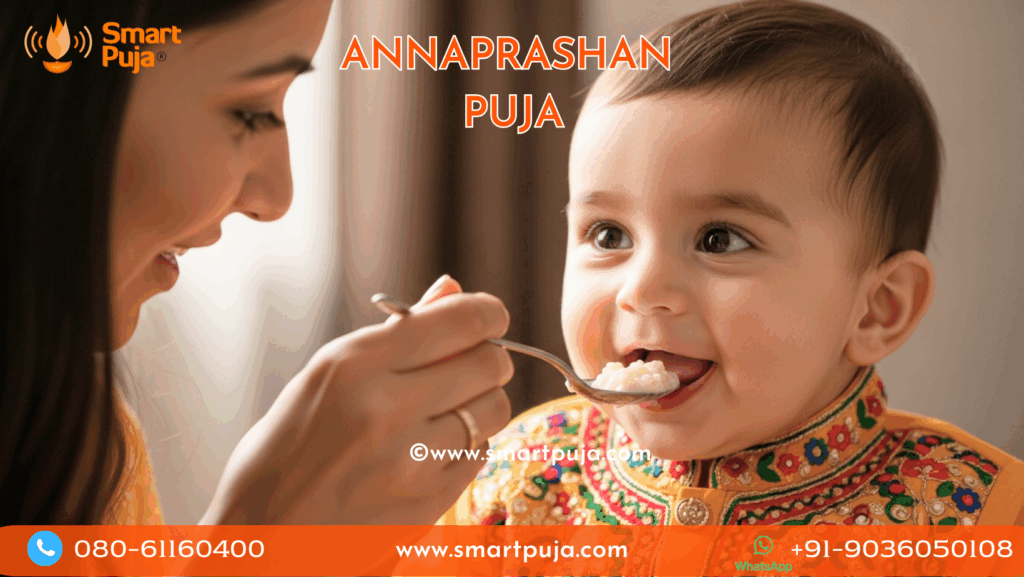
- The Feeding: The baby sits on the maternal uncle’s or father’s lap. A silver bowl containing Kheer (sweet rice pudding) or mashed rice with ghee is used. The food is blessed with Mantras before being gently fed to the baby using a silver spoon or gold ring.
The Fun Ritual: Choosing the Future
The most entertaining part of Annaprashan is the “game of objects.” A tray containing several items is placed in front of the child. It is believed that the object the baby touches first predicts their future inclination/profession.
Books / Pen
Symbolizes Knowledge & Wisdom (Saraswati).
Gold / Coins
Symbolizes Wealth & Business (Lakshmi).
Clay / Soil
Symbolizes Property or Groundedness.
Food Items
Symbolizes a Love for Food or Charity.
How SmartPuja Helps You Celebrate?
Organizing a ceremony with a small baby can be stressful. SmartPuja takes the hassle out of the rituals.
- Verified Pandits: We provide experienced priests who can perform the Puja in your language (Hindi, Bengali, Kannada, Telugu, etc.).
- Samagri Included: Our packages cover Pandit Ji’s Dakshina, Travel, and all Puja Samagri (flowers, leaves, homa samagri etc.). Customer only need to arrange basic household vessels with prasad items. A checklist is shared for your reference.
- City-Wide Service: Whether you are in Kolkata, Bangalore, or Delhi, we serve 14000+ pin codes.
Frequently Asked Questions
Usually, Kheer (Payasam) made of rice, milk, and sugar/jaggery is the first food. In some cultures (like Bengal), mashed fish and vegetables are also offered after the sweets.
Yes, absolutely. While some prefer temples, performing it at home is very common and more comfortable for the baby. SmartPuja can send a Pandit to your home.
For boys, it is usually the 6th or 8th month. For girls, it is the 5th or 7th month. Consult our astrologers to find the exact Shubh Muhurat based on the baby’s Nakshatra.