What Happens After Death According to Garuda Purana? (Soul’s…
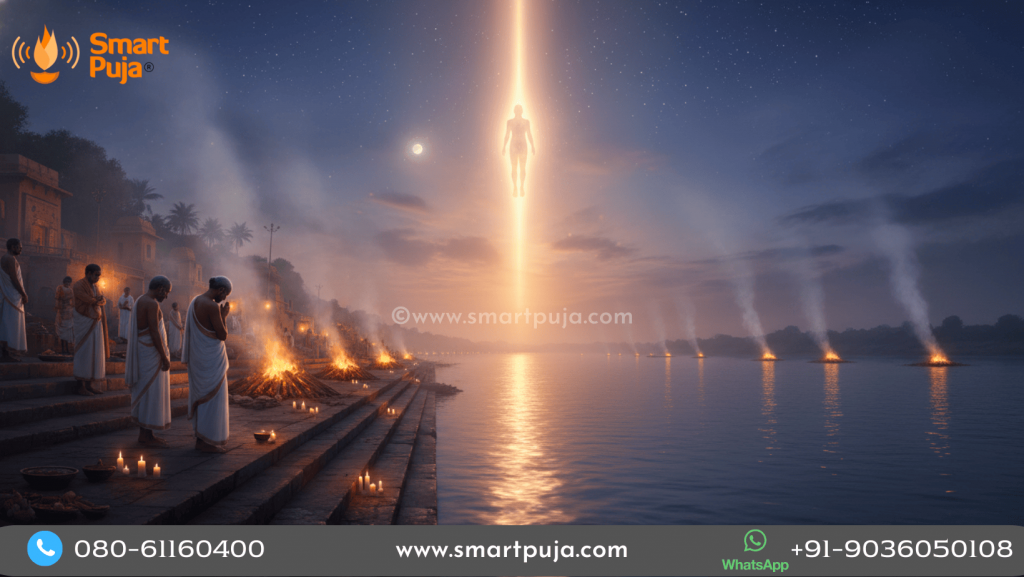
What Happens After Death According to Garuda Purana? (The Soul’s Journey)
What Happens Immediately After Death? (Short Answer)
According to the Garuda Purana, immediately after death, the soul leaves the physical body and assumes a thumb-sized subtle body (Angustha Matra). The soul stays near its home and family for 13 days. Through the daily offering of Pind Daan by the family, the soul forms a new spiritual body, which it then uses to travel the 86,000 Yojanas to Yamaloka (the realm of the dead) for cosmic judgment.
In Hinduism, death is not a full stop; it is merely a comma. It is the shedding of an old garment to put on a new one. However, the transition from the physical world to the spiritual realm is a complex, often daunting journey. To understand this journey, we turn to the profound wisdom of the Garuda Purana.
Need an Antyesti Pandit Today? Call Now.
We understand this is a difficult time. SmartPuja provides immediate, compassionate assistance for Antyesti, Cremation Rituals, and 13-Day Shradh with verified Vedic Pandits across India.
Which Chapters of Garuda Purana Describe the Afterlife?
The Garuda Purana is one of the 18 Mahapuranas. To establish spiritual authority on this topic, it is important to know that the text is primarily divided into sections. The specific details regarding the soul’s journey, the afterlife, and funeral rites are found entirely within the Preta Khanda (also sometimes referred to in connection with the Dharma Khanda).
It is essentially a divine dialogue where Lord Vishnu answers the deeply compassionate questions of his mount, Garuda, regarding what happens to humans after they take their final breath.
Why is it Read After Death?
It is a strict Hindu tradition to organize a Garuda Purana Path at the deceased’s home during the 13 days of mourning. Because the soul remains in the house during this time, listening to the Purana helps the soul detach from its family, let go of worldly desires, and find the courage to begin its onward journey.
People Also Ask: Does the Soul Feel Pain After Death?
A common question is whether the soul experiences pain without a physical body. According to Vedic philosophy, the physical body (Sthula Sharira) dies, but the subtle body (Linga Sharira)—which houses the mind, ego, and Karmic impressions—survives.
Therefore, the soul does not feel physical pain like a cut or a burn, but it experiences deep emotional and psychological pain—such as grief, intense attachment to loved ones, and the unfulfilled desires of its past life. This is why calming the soul through prayers is paramount.
The Exact Journey of the Soul After Death in Hinduism
The Garuda Purana breaks down the journey of the soul after death into distinct chronological phases.
Phase 1: The Moment of Extraction (Day 1)
When the time of death arrives, the physical body begins to shut down. The five senses stop working. At this moment, two messengers of Yama (the God of Death), known as Yamadootas, arrive to extract the soul.
- For Sinners: The soul is forcefully extracted, which is described symbolically as undergoing a rigorous and challenging passage.
- For the Righteous: The soul exits peacefully from the upper chakras (mouth, nose, or the crown of the head), guided gently by divine beings.
Once extracted, the soul assumes a thumb-sized invisible form. The Yamadootas briefly take the soul to Yamaloka to show it a glimpse of its destination, but immediately bring it back to its earthly home.
Phase 2: The 13-Day Stay at Home (The Preta Stage)
Upon returning to its house, the soul finds its physical body being cremated. It cries out, tries to speak to its grieving family, and attempts to re-enter the ashes, but it cannot. Because it has lost its physical body but still retains its desires, hunger, and thirst, it is now referred to as a Preta (a wandering spirit).
For the next 10 days, the soul survives solely on the essence of the food and water offered by the family during the mourning rituals.
The Importance of the 13-Day Death Rituals (Antyesti)
According to the Garuda Purana, the soul cannot travel to Yamaloka in its thumb-sized body; it needs a “travel body” (Bhog Deha) to endure the journey. This new body is constructed piece by piece through the Pind Daan (offering of rice and sesame seed balls) performed by the family.
| Day of Offering | Body Part Formed for the Soul’s Journey |
|---|---|
| Day 1 Pinda | Forms the Head |
| Day 2 Pinda | Forms the Neck and Shoulders |
| Day 3 Pinda | Forms the Heart and Chest |
| Day 4 Pinda | Forms the Back and Spine |
| Day 5 Pinda | Forms the Navel and Abdomen |
| Day 6 Pinda | Forms the Groin and Lower Body |
| Day 7 Pinda | Forms the Thighs |
| Day 8 Pinda | Forms the Knees |
| Day 9 Pinda | Forms the Legs and Feet |
| Day 10 Pinda | Grants the capacity to feel hunger and thirst |
On the 11th and 12th day, extensive Shradh rituals are performed, ending the impurities of the family. Finally, on the 13th day (Tehrvi), the soul is officially upgraded from a Preta (wandering spirit) to a Pitru (ancestor). The Yamadootas return, bind the soul, and the long journey to Yamaloka begins.
If you are seeking guidance to perform these critical rituals correctly, you can explore our complete Shradh & Antyesti services here.
Phase 3: The Journey to Yamaloka (Day 14 to Day 365)
The journey to Yamaloka takes a full 12 earthly months (approx. 348 days). The soul must cross 86,000 Yojanas of dark, barren terrain.
Its only sustenance on this long journey is the monthly Shradh (Masik Shradh) food offered by its family back on earth.
Crossing the Vaitarani River
Midway through the journey, the soul encounters a major obstacle: The Vaitarani River.
Rather than a standard body of water, the Vaitarani is described symbolically as a difficult, turbulent, and painful crossing representing the accumulated impurities of a person’s life.
- For the Wicked: The soul struggles agonizingly to cross the turbulent currents of its own negative karma.
- For the Virtuous: A boat miraculously appears to ferry the righteous soul across safely.
This is why Hindus perform Gau Daan (Donating a Cow). The Purana states that the soul who donated a cow (or whose family did on their behalf) will be able to hold onto the cow’s tail and safely cross the Vaitarani river.
The Final Judgment: Chitragupta and Yama
Upon finally reaching Yamaloka after a year, the soul stands before Lord Yama, the God of Justice. Sitting beside him is Chitragupta, the divine record-keeper who holds the “Akashic Records”—a flawless ledger of every single thought, word, and deed the soul performed during its earthly life.
There are no secrets here. Based on this Karmic ledger, Lord Yama delivers the judgment.
Different Interpretations Across Hindu Texts
While the Garuda Purana focuses heavily on the mechanics of karma and the literal journey of the subtle body, other foundational Hindu texts provide a more philosophical balance:
- Bhagavad Gita (Chapter 2): Lord Krishna explains that the soul is eternal and cannot be destroyed. Death is merely the soul discarding an old body to put on a new one, much like changing clothes.
- Katha Upanishad: Features the famous dialogue between the young boy Nachiketa and Lord Yama, focusing heavily on Moksha (spiritual liberation) and realizing the true nature of the self, rather than focusing on punishment.
The 3 Paths of the Soul After Judgment
Depending on its Karma, the soul is directed to one of three paths:
- Swarga (Heaven): For those who lived righteous, charitable, and pious lives, they are sent to Swarga to enjoy heavenly pleasures. Once their good karma runs out, they return to earth and are reborn.
- Naraka (Hell): Souls with heavy bad karma are sent here to undergo specific purifications to burn off their sins before being reborn, often in lower life forms.
- Pitru Loka: The realm of ancestors. Souls wait here until it is time for their next reincarnation.
Note: Supreme devotees of the Lord who have achieved absolute detachment bypass Yamaloka entirely and achieve Moksha, merging with the divine.
What Happens If Death Rituals Are Not Performed Properly?
The Garuda Purana gives a stark warning: If a person dies an unnatural death (accident, suicide), or if the family fails to perform the 13-day Antyesti and Pind Daan rituals, the soul’s “travel body” is never properly formed.
Scriptures describe that improper or incomplete rituals may cause spiritual unrest, potentially keeping the soul bound to the earthly realm. It wanders, hungry and in pain. In its frustration, this trapped ancestor unknowingly brings suffering upon its own living family—a phenomenon known in Vedic astrology as Pitru Dosha.
Is Your Family Suffering from Unexplained Obstacles?
If an ancestor passed away unnaturally, or if death rituals were missed generations ago, your family might be suffering from Pitru Dosha. The scriptural remedy for this is the powerful Narayan Nagbali Puja.
Ensure Your Ancestors Achieve Peace
Performing accurate death rituals is the highest duty of a family in Hinduism. It ensures the soul safely crosses the Vaitarani river and blesses the family from above.
Why Book Shradh & Antyesti Rituals with SmartPuja?
- ✔ Strict Scriptural Compliance: Rituals performed exactly as per Garuda Purana.
- ✔ Experienced Vedic Pandits: Specialists in Antyesti, Shradh, and Pind Daan.
- ✔ All Samagri Included: We bring all required items so you can focus on mourning and prayer.
We provide verified Pandits for Shradh, Tehrvi, and Pitru Paksha across major cities:
⭐ 4.8/5 Rated by Devotees | Trusted by 85,000+ Families
Frequently Asked Questions
1. What happens immediately after death in Hinduism?
According to the Garuda Purana, immediately after death, the messengers of Yama (Yamadootas) arrive to extract the soul from the physical body. The soul then assumes a thumb-sized subtle body (Angustha Matra) and remains near its home for 13 days.
2. Why do Hindus observe 13 days of mourning after death?
The soul (Preta) stays around its earthly home for 12 days, still attached to its family. On the 13th day, through the Pind Daan and Tehrvi rituals, the soul gains the strength to cut its earthly ties and begin its spiritual journey to Yamaloka.
3. What is the Vaitarani River in the Garuda Purana?
The Vaitarani River is described symbolically as a difficult and painful crossing that the soul must navigate on its way to Yamaloka. Souls heavily burdened by negative karma struggle here, while righteous souls cross it easily.
4. What happens if death rituals (Antyesti) are not performed properly?
Scriptures describe that improper or incomplete rituals may cause spiritual unrest, potentially keeping the soul bound to the earthly realm as a wandering spirit (Preta). This can cause suffering to the soul and bring ‘Pitru Dosha’ upon the living family.
5. Can reading the Garuda Purana help the departed soul?
Yes, reading or organizing a Garuda Purana Path at home during the 13 days of mourning provides spiritual knowledge to the wandering soul, helping it detach from worldly desires.
6. Is Garuda Purana scientifically true?
The Garuda Purana is a theological and spiritual text, not a scientific manual. It uses deep symbolism and allegory to explain the metaphysical consequences of karma, human morality, and the conservation of energy (the soul) beyond physical death.
7. How long does the soul stay on earth?
According to Hindu scriptures, the soul typically lingers around its earthly home and loved ones for 13 days after physical death, waiting for the completion of the Antyesti rituals.
8. What happens on the 10th day ritual?
The 10th-day ritual (Daswan) is crucial. It is believed that through the offerings made on this day, the subtle body of the soul regains the capacity to feel hunger and thirst, preparing it for the final separation from the family.
9. Can women attend Shradh rituals?
Yes. While traditionally men (specifically the eldest son) perform the core Pind Daan, women are actively involved in the preparation, prayers, and feeding of the Brahmins. In modern times and in the absence of male heirs, women also perform the primary rituals.
10. What is Preta Loka?
Preta Loka is an intermediate, temporary spiritual dimension. Souls that are deeply attached to the physical world, or those who have not received proper death rituals, reside here as ‘Pretas’ (spirits) before transitioning to Pitru Loka.
11. What is the difference between Shradh and Pind Daan?
Pind Daan is the specific physical act of offering round balls of rice and sesame seeds to nourish the soul’s subtle body. Shradh is the broader, complete ritual process performed with deep faith (Shraddha) to honor and satisfy the ancestors.